18 Dec 2025
6 min read
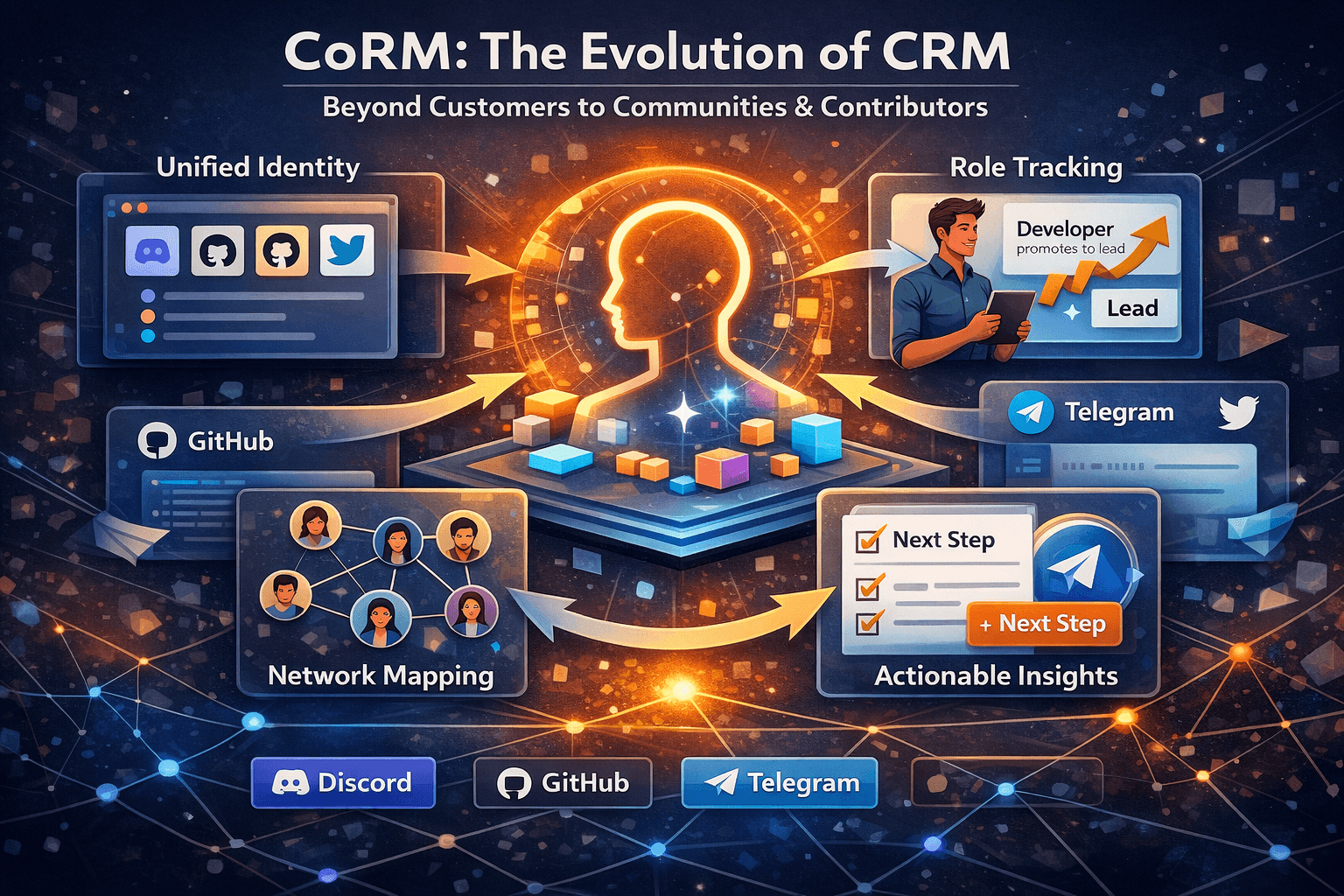
Community Relationship Management (CoRM) is the evolution of CRM for modern, decentralised teams. This guide explains what a CoRM is, why Web3 communities need it, and how it unifies Discord, Telegram, GitHub, and contributor data into clear insights and next-step actions.
Once upon a time, all you needed to grow a business was a good product, a handshake, and maybe a decent CRM. Today? If you’re not tracking conversations across platforms such as Discord, Telegram, GitHub and X, you might be flying blind…
Relationships in business have evolved. It’s no longer just about customers; it’s about communities, contributors, partners, and internal collaborators.
While CRMs like Salesforce and HubSpot track sales pipelines and customer interactions, CoRMs take it further, offering a more holistic view of all the human connections that fuel your organisation.
As work becomes more decentralised and community-led, especially in spaces like Web3 and open-source ecosystems, managing these relationships becomes both critical and complex.
Enter CoRM, a new category designed to bring clarity to the chaos by helping teams understand who’s doing what, where, and what to do next.
So, what does this look like?
CoRM is the evolution of CRM, expanding relationship tracking beyond customers to communities, contributors, and partners.
Traditional CRMs are vertical, focused on sales and customer data; CoRMs are horizontal, integrating diverse human interactions.
CoRM offers actionable intelligence, not just analytics, it helps answer, “What should we do next?”
Modern collaboration happens across tools like Discord, GitHub, and Slack, CoRMs unify this data.
Ideal for Web3 projects, dev communities, and ecosystem teams managing relationships at scale.
Why Web3 Teams Can’t Survive Without a CoRM
In a Web3 ecosystem, your community isn’t just a “marketing funnel”; it’s your product adoption engine, governance body, and sometimes even your technical support team. The traditional CRM falls short in this setting for several reasons:
1. Multi-platform, messy footprint
Your contributors aren’t just “leads” in Salesforce. They’re active in Discord threads, Telegram groups, code commits on GitHub, governance proposals on Snapshot, and token-holder discussions on X.
Discord itself highlights this fragmentation in its community moderation guidelines. There’s no unified identity across these worlds unless you build one.
A CoRM pulls everything into a single profile so you can see the full picture of a contributor’s journey.
2. Dynamic, peer-driven roles
In Web3, everything is fluid. Someone starts as a lurker, becomes a PR reviewer, then suddenly leads a working group. GitHub’s contributor guidelines even outline these non-linear roles.
A CoRM tracks these shifts and prompts your team with “who’s emerging”, not just “who’s active”.
3. Your Community Isn’t a Sales Funnel, It’s a Network Map
Web3 communities rely on contributors, partners, referrers, token-holders and friendly ecosystem teams. These aren’t sales relationships; they’re networks. Harvard Business Review’s article “How Leaders Create and Use Networks” shows how network mapping outperforms traditional hierarchy in understanding influence.
A CoRM maps these networks inside your community.
4. From insight to action
Analytics alone don’t tell you what to do. A CoRM does.
For example, the Ethereum Foundation’s community research emphasises contextual engagement, understanding why someone is active, not just that they are.
A CoRM turns that insight into an action recommendation automatically.
What Does a CoRM Actually Track?
Here are the building blocks of a CoRM, your checklist as you evaluate or build one.
One Identity to Rule All Your Channels
Each person gets a profile that spans platforms.
SavannahHQ explains this as building a unified, cross-platform identity.
Who They Were, Who They Are, Who They’re Becoming
Track evolving roles and intent signals like:
submitted a proposal
became a working group lead
volunteered for something
flagged interest in partnership
Relationship Linkages
Who collaborates with whom? Who mentors whom?
Engagement Health Metrics
Including the quality of participation, not just quantity.
Indeed summarises this as understanding “who does what, and why it matters” in community teams (https://uk.indeed.com/career-advice/finding-a-job/what-does-community-manager-do?utm).
Recommended Next Actions
The differentiator between CoRM and “dashboard tools”.
How a CoRM Becomes Your Team’s Second Brain
Onboarding & Profile Creation
When someone joins Discord, GitHub or Telegram, the CoRM builds their identity.
Engagement Monitoring
It watches activity trends not to babysit members, but to spot meaningful signals.
Role Evolution
When a member becomes a contributor or moderator, the profile updates.
Relationship & Referral Mapping
You see how influence flows inside your community.
Action Recommendation
The CoRM prompts your team with “here’s what to do next”.
Feedback Loop
You get sharp insights on what’s working and where contributors drop off.
The Rookie Mistakes That Kill Community Insight
Treating the community like a funnel
Communities aren’t linear. CoRMs embrace this complexity.
Siloing data
Discord data in one sheet, GitHub usernames in another… avoid this chaos.
No workflow triggers
Data without automation = more manual work.
Focusing only on message counts
“High activity” doesn’t equal “healthy community”.
How to Choose or Build a CoRM
Look for tools that support:
multi-platform identity
relationship graphs
behavioral analytics
next-step recommendations
role tracking
flexible workflows
collaboration-ready data
If you’re building in-house, it’s doable, but maintenance becomes expensive at scale.
The Bottom Line: Communities Deserve Better Tools
If you’re running a Web3 community, ecosystem programme or contributor network, a CoRM isn’t a luxury; it’s the next natural evolution of your operations stack.
Communities today sit across Discord threads, governance votes, GitHub commits, Telegram chats and contributor calls. Only a CoRM shows you the whole picture, helps you act, and keeps your team aligned on what to do next.